It is one of the most frustrating moments an Oxford driver can experience: you are driving along Jackson Avenue, commuting down Highway 6, or pulling out from the Ole Miss campus when an amber engine icon suddenly illuminates on your dashboard.
Your immediate reaction is often a mix of anxiety and uncertainty. Does a Check Engine light mean your car is on the verge of breaking down, or is it simply a minor sensor alert? Because the dashboard icon looks identical whether your gas cap is loose or an engine cylinder is actively misfiring, knowing how to interpret the warning—and taking the right next steps—is crucial for protecting your engine and your repair budget.
Understanding the urgency levels, recognizing common causes, and learning how professional diagnostic scans work ensures you handle a Check Engine Light Oxford alert with complete confidence.
Steady vs. Flashing Warning: Assessing Urgency Immediately
When your vehicle’s Powertrain Control Module (PCM) detects an operational value outside factory specifications, it triggers your Check Engine light. However, the way the light behaves tells you how urgently you need to react:
- Steady / Solid Amber Icon: A solid amber or yellow Check Engine light indicates a non-emergency fault within your vehicle’s emissions, fuel delivery, or electronic sensor network. You can generally drive your vehicle a short distance home or to a safe destination. However, you should avoid heavy towing, hard acceleration, or long highway road trips until you schedule a professional Check Engine Light Oxford diagnostic inspection.
- Flashing / Blinking Icon: A flashing or blinking Check Engine light is a critical warning signal. It indicates an active, severe engine misfire where raw, unburned gasoline is passing directly through the engine cylinders and into the hot exhaust system. Pull over and stop somewhere safe immediately. Continuing to drive with a flashing Check Engine light can melt the internal catalyst core of your catalytic converter within minutes, turning a simple ignition repair into an expensive multi-thousand-dollar exhaust overhaul. Turn off the ignition and seek prompt Check Engine Light Oxford diagnostic guidance.
Common Causes Behind a Check Engine Light Oxford Alert
An illuminated warning light is an alert, not a precise repair manual. While dozens of independent faults can trigger the light, several common failure points frequently lead to a Check Engine Light Oxford service request:
| Potential Failure Point | Primary Function in Vehicle | Common Symptoms & Impact |
| Ignition System (Coils / Plugs) | Ignites air-fuel mixture in cylinders | Engine stumbling, rough idling, hesitation under load, or flashing Check Engine Light Oxford warning |
| EVAP & Gas Cap Seals | Traps gasoline vapors in fuel tank | Solid Check Engine light or “Check Gas Cap” message; no obvious driving changes |
| Mass Air Flow (MAF) Sensor | Measures incoming air volume for PCM | Stalling, poor throttle response, or sudden drops in fuel economy |
| Oxygen ($O_2$) Sensors | Monitors unburned oxygen in exhaust | Higher fuel consumption, poor emissions output, and potential catalyst strain |
| Thermostat & Cooling System | Regulates engine operating temperature | Engine running too cold or running hot; delayed heater cabin warming |
Deep Dive: How OBD-II Codes Work (And Why Codes Aren’t Answers)
When a technician performs a Check Engine Light Oxford diagnostic scan, they connect specialized scan equipment to your vehicle’s On-Board Diagnostics (OBD-II) port to pull Diagnostic Trouble Codes (DTCs).
A common misconception among drivers is that an OBD-II fault code identifies the exact part that needs to be replaced. In reality, fault codes simply point to the system or circuit that is reporting anomalous data.
Code Interpretation Example: Ford & Lincoln P0300 Misfire Codes
For example, on a Ford F-150 EcoBoost or a Lincoln Navigator, an OBD-II scan might retrieve code P0302 (Cylinder 2 Misfire Detected). The code does not mean “replace Cylinder 2 ignition coil.” A Cylinder 2 misfire can be caused by:
- A worn or fouled spark plug gap requiring maintenance during a Check Engine Light Oxford check.
- A failing ignition coil pack or damaged wiring harness.
- A clogged or electrically faulted fuel injector.
- Low mechanical compression due to a sticky valve or cylinder wear.
- An intake manifold vacuum leak near that specific cylinder runner.
A diagnostic code provides the starting point for testing—not the final answer. An experienced technician uses live sensor data logging, digital multimeter testing, and physical inspection to verify the underlying cause before replacing components.
Step-by-Step Diagnostic Process for Check Engine Light Oxford Alerts
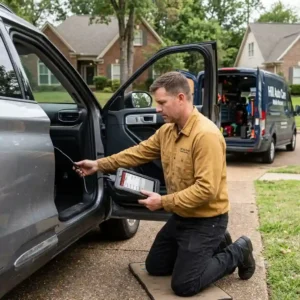
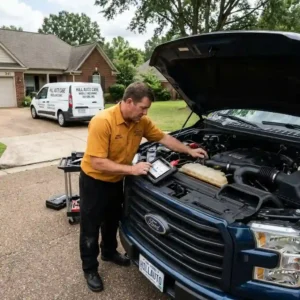
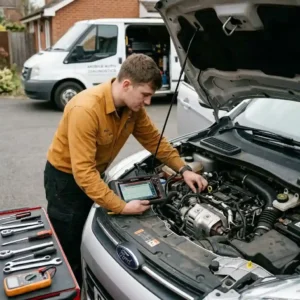
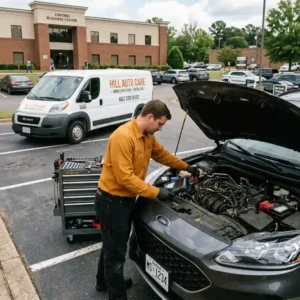
To truly solve a Check Engine Light Oxford issue without throwing unnecessary parts at your car, professional mobile technicians follow a systematic multi-step testing process right in your driveway:
- Step 1: On-Board Diagnostics Retrieval
The technician plugs in a professional bi-directional scanner to capture active trouble codes, pending fault codes, and history records. This initial step isolates which specific system triggered the Check Engine Light Oxford alert. - Step 2: Freeze-Frame Data Analysis
Freeze-frame data acts like a digital snapshot taken by your car’s computer at the exact millisecond the fault occurred. It records crucial variables such as vehicle speed, engine RPM, engine coolant temperature, and fuel trim percentages. Analyzing this data helps explain why the Check Engine Light warning was activated. - Step 3: Live PID Stream Monitoring
With the engine running, the technician monitors live parameter identification (PID) streams. Watching sensor voltage fluctuations, airflow calculations, and misfire counts in real time allows the technician to catch intermittent electrical issues that standard code readers miss during a Check Engine Light scan. - Step 4: Physical Component & Circuit Verification
Before concluding that a sensor has failed, physical testing must confirm proper ground continuity, reference voltage, and vacuum integrity. Testing components directly ensures your Check Engine Light repair targets the true root cause.
Why Choose Hill Auto Care for Check Engine Light Testing in Oxford
When a Check Engine light appears unexpectedly on your dashboard, HILL AUTO CARE provides reliable, data-driven mobile diagnostic support brought straight to your home or workplace across Lafayette County.
- 10+ Years of Professional Automotive Experience: With over a decade of hands-on mechanical and diagnostic knowledge, HILL AUTO CARE handles complex electrical and drivability issues for all domestic and import vehicles.
- Specialized Ford & Lincoln Diagnostic Equipment: Equipped with advanced manufacturer-level scan tools, we excel at deep computer diagnostics, live parameter stream monitoring, and bi-directional testing for Ford trucks, SUVs, and Lincoln platforms alongside all major automotive brands needing a Check Engine Light Oxford evaluation.
- Upfront Communication & Clear Estimates: We explain all diagnostic scan findings in straightforward language and provide itemized estimates before any repair work begins, ensuring complete transparency for your Check Engine Light Oxford service.
Learn more about our local standards on our ABOUT US page, review our complete suite of on-site service options on our SERVICES page, or request a diagnostic appointment directly via our CONTACT US page!
Practical Checklist When Your Check Engine Light Appears
If your dashboard warning light turns on today, follow this quick driver decision checklist:
- Check Light Behavior: Is the Check Engine light steady or flashing? If flashing, pull over safely and turn off the engine immediately to prevent severe damage.
- Inspect the Gas Cap: If the light is solid, pull into a safe area, remove the gas cap, re-install it until it clicks, and drive over a few normal drive cycles to see if the system resets.
- Note Driving Changes: Pay attention to whether the engine is idling roughly, hesitating during acceleration, or making unusual noises while driving around Oxford.
- Schedule a Professional Diagnostic Scan: Book a dedicated Check Engine Light Oxford scan to read active, pending, and freeze-frame computer data.
For official guidance on vehicle safety recalls, dashboard warning standards, and general consumer advice, consult the National Highway Traffic Safety Administration (NHTSA) and the United States Environmental Protection Agency (EPA) Vehicle Emission Portal.
Frequently Asked Questions
Can I drive with a steady Check Engine light on?
Yes, for a short distance. A solid amber Check Engine light indicates a non-emergency issue, such as a minor sensor fault or EVAP leak. However, you should schedule a Check Engine Light Oxford diagnostic scan promptly to prevent secondary damage or reduced fuel economy.
What should I do if my Check Engine light is flashing?
A flashing light indicates a severe, active engine misfire that can rapidly damage your catalytic converter. Safely pull off the road immediately, turn off the engine, and seek professional Check Engine Light Oxford assistance.
Will a Check Engine light turn off on its own?
If the underlying issue was temporary—such as a loose gas cap that has been tightened—the Powertrain Control Module may clear the light automatically after running a series of successful self-tests over several driving cycles.
Why can’t auto parts store code readers confirm what part to buy?
Basic code readers only read the alphanumeric trouble code (e.g., P0171 – System Too Lean). They cannot perform live sensor logging, bi-directional actuator tests, or physical circuit diagnostics required during a proper Check Engine Light Oxford evaluation.
How do I schedule a Check Engine light diagnostic scan with Hill Auto Care in Oxford, MS?
Reach out to HILL AUTO CARE through our CONTACT US page with your vehicle details and warning light behavior to book an on-site Check Engine Light Oxford diagnostic visit.
Get Clear Answers for Your Dashboard Warning Today
Don’t let an unexpected warning light cause unnecessary stress or leave you guessing. Securing a professional, accurate Check Engine Light Oxford diagnostic assessment provides the data needed to keep your vehicle running safely and efficiently across Lafayette County.
For broader diagnostic and repair insights, explore our specialized guides on Car Diagnostic Oxford, review our Ford Repair Oxford solutions, or contact HILL AUTO CARE today via our CONTACT US page!