Few dashboard warnings cause more confusion for drivers along Highway 6 or near the Ole Miss campus than an illuminated Check Engine light paired with an emissions-related fault code. You might notice your vehicle driving completely normally—without any engine misfires, knocking, or sudden power loss—yet the amber warning light remains steadily lit on your instrument cluster.
In many cases, these alerts point directly to an issue within your vehicle’s Evaporative Emission Control (EVAP) system. Understanding how this vital system operates, recognizing early warning signs, and knowing why professional testing is necessary before replacing parts can save you time, money, and unnecessary stress when scheduling an EVAP System Repair Oxford service.
What Does the EVAP System Do?
The EVAP system is a closed environmental control network designed to capture raw gasoline vapors inside your fuel tank and prevent them from escaping into the open air. Gas tank vapors contain volatile organic compounds (VOCs) that contribute to smog and air pollution.
Instead of venting these fumes into the atmosphere, the EVAP system routes them into a charcoal canister filled with activated carbon. When you drive under normal highway conditions, your vehicle’s Powertrain Control Module (PCM) opens a purge valve. This draws the stored vapors out of the canister and into the engine’s intake manifold, where they are safely burned during normal combustion.
Why EVAP Fault Codes (P0442 & P0455) Require Investigation
When your car’s onboard diagnostics run an automated self-test, it pressurizes or pulls a vacuum on the fuel system to verify seal integrity. If the system detects a loss of pressure, it triggers a Diagnostic Trouble Code (DTC):
- P0442 (Small Leak Detected): Indicates a minor vapor leak, often equivalent to a hole smaller than 0.04 inches in diameter.
- P0455 (Gross Leak Detected): Indicates a major vapor leak or a complete lack of system pressure retention.
Crucially, an EVAP fault code does not identify a specific failed component; it simply alerts you that the system cannot hold sealed pressure. Treating a P0442 or P0455 code as an automatic directive to replace a purge valve or buying a new gas cap often leads to wasted money on functional parts. Systematic testing is required to isolate the exact source of the leak prior to initiating an EVAP System Repair Oxford job.
5 Signs Your Vehicle May Need EVAP System Repair Oxford
While an EVAP failure rarely causes an immediate breakdown on the road, watching for these five distinct indicators helps you determine when to request an EVAP System Repair Oxford inspection:
1. Persistent Check Engine or Gas Cap Light
The most common sign requiring an EVAP System Repair Oxford evaluation is an illuminated Check Engine light or a dedicated “Check Gas Cap” message on your instrument cluster.
2. Fuel Odors Around the Vehicle
If you smell raw gasoline fumes near the rear quarter panel, near the gas cap, or under the hood while parked in your driveway, vapor is actively escaping the sealed EVAP circuit and demands a targeted EVAP System Repair Oxford check.
3. Difficulty Starting After Refueling
If your engine hesitates, cranks excessively, or stumbles immediately after filling up at a local gas station, a purge valve stuck in the open position may be pulling raw fuel vapors into the intake manifold, flooding the engine and signaling a need for EVAP System Repair Oxford diagnostic testing.
4. Rough Idling or Minor Idle Fluctuations
A purge valve that fails to close completely creates an unmetered vacuum leak into the intake manifold, causing the engine idle speed to surge or dip at red lights.
5. Slightly Reduced Fuel Economy
Because escaping vapors represent unburned fuel that should have been routed to the combustion chamber, a compromised EVAP system can lead to a subtle drop in overall fuel efficiency over time until an EVAP System Repair Oxford service restores full system seals.
Common Causes Behind EVAP Leaks
A breakdown anywhere along the sealed EVAP circuit can trigger a warning light. Common physical failure points that lead to an EVAP System Repair Oxford service call include:
| Component | Function in EVAP Circuit | Potential Cause of Failure |
| Fuel Filler Cap | Seals the filler neck opening | Cracked rubber O-ring seal, worn locking tabs, or loose installation. |
| Purge Solenoid Valve | Controls vapor flow into the intake engine manifold | Internal valve stuck open/closed or electrical solenoid failure. |
| Vent Solenoid Valve | Regulates fresh air flow into the charcoal canister | Debris blockages, internal mechanical sticking, or wiring corrosion. |
| Vapor Hoses & Lines | Connects tank, canister, and engine intake manifold | Dry rot, cracking from age, loose quick-connect fittings, or road damage. |
| Charcoal Canister | Stores fuel vapors until purge cycle begins | Physical cracks from road debris, water intrusion, or fuel saturation. |
Safety Advice: Why DIY Disassembly Is Not Recommended
Dealing with automotive fuel systems requires strict safety precautions. Gasoline vapors are highly volatile, flammable, and toxic when inhaled in enclosed spaces.
Attempting to dismantle fuel lines, remove charcoal canisters, or drop fuel tanks in a home garage introduces severe fire hazards and risks damaging sensitive electronic sensors or quick-connect plastic fittings. Aside from checking that your gas cap is tight and undamaged, deeper EVAP inspection should always be left to a trained professional equipped for EVAP System Repair Oxford tasks with proper safety gear and containment equipment.
How Professional EVAP System Repair Oxford Diagnostics Work
When you schedule an EVAP System Repair Oxford diagnostic service, a technician follows a structured testing sequence to isolate the leak without replacing unnecessary parts:
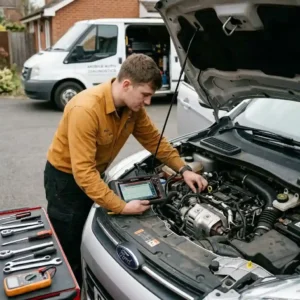
- OBD-II Scan & Live Data Review: The technician checks active and pending DTCs, reviews PCM freeze-frame data, and tests bi-directional command responses for the purge and vent solenoids.
- Visual & Pressure Testing: Inspecting vapor lines, hose connections, and the fuel cap seal for visible cracking or damage.
- Smoke Machine Diagnostic Testing: For microscopic leaks, technicians connect an EVAP-approved smoke machine that pumps low-pressure inert smoke into the closed system. Escaping smoke immediately reveals the exact location of a cracked hose, leaking seal, or pinhole tear to ensure precise EVAP System Repair Oxford execution.
Mobile Diagnostics vs. Workshop Needs
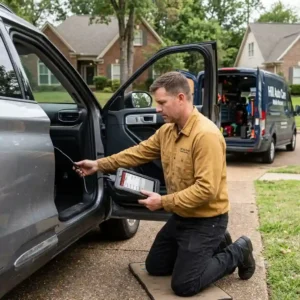
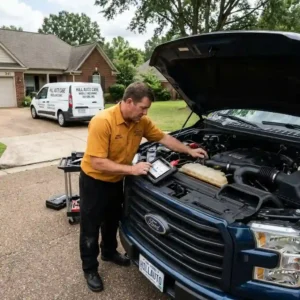
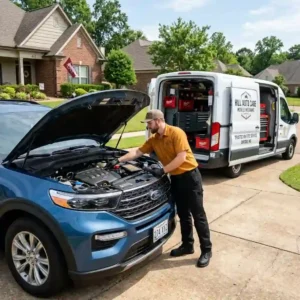
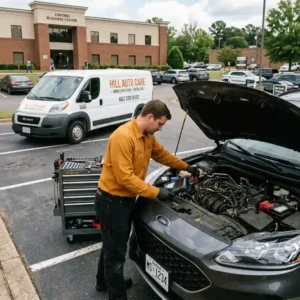
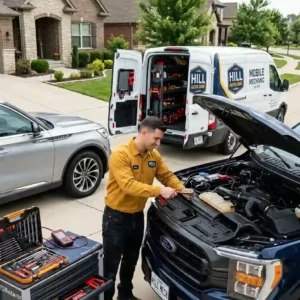
Many EVAP diagnostic steps—such as initial computer scans, solenoid circuit testing, gas cap checks, and targeted smoke testing—can be performed conveniently on-site at your home or workplace. However, if testing reveals that a rusted fuel tank filler neck must be replaced or an inaccessible charcoal canister mounted above the rear subframe requires major component disassembly, shop lifts and specialized workshop facilities may be required.
Why Choose Hill Auto Care for EVAP System Repair Oxford
At HILL AUTO CARE, we provide expert, data-driven diagnostic support and repair services for drivers across Lafayette County.
- Advanced Diagnostic Tools:We utilize professional scan equipment and specialized testing gear to isolate EVAP leaks accurately before recommending any EVAP System Repair Oxford procedure.
- Specialized Ford & Lincoln Knowledge: We bring deep technical familiarity with Ford and Lincoln platform architectures—including capless Easy Fuel systems and EcoBoost purge valve circuits—alongside all major import and domestic makes.
- Transparent Communication:You receive an itemized explanation of diagnostic findings and a clear estimate before any EVAP System Repair Oxford work proceeds.
Learn more about our local standards on our ABOUT US page, review our full suite of diagnostic options on our SERVICES page, or reach out to schedule service directly through our CONTACT US page!
Practical Checklist Before Scheduling Your Inspection
Before booking an EVAP System Repair Oxford inspection, go through these quick preliminary steps:
- Check Your Fuel Cap: Remove the cap, inspect the rubber gasket for cracks, re-install it until it clicks, and drive for a few days to see if the light resets.
- Note Specific Driving Behaviors: Pay attention to whether your car struggles to start after refueling or exhibits idle fluctuations at stops.
- Record Dashboard Codes: If you have had your codes scanned at an auto parts store, write down the exact code numbers (such as P0442, P0455, or P0496) for your technician.
For official information regarding vehicle emissions compliance, environmental safety standards, and air quality guidelines, consult the United States Environmental Protection Agency (EPA) Transportation & Air Quality Hub.
Frequently Asked Questions
Is it safe to drive with an EVAP system leak code?
Yes, in most cases it is safe to drive short distances because an EVAP leak does not directly threaten mechanical engine components. However, ignoring it allows harmful gasoline vapors to escape into the air and prevents your vehicle from passing state emissions testing.
Can a loose gas cap clear an EVAP Check Engine light automatically?
If a loose gas cap caused the code, tightening it will fix the leak. However, the Check Engine light may take several complete driving cycles (often a few days of normal driving) for the PCM to run a self-test and clear the light automatically.
Why does my car struggle to start only right after I fill up at the gas station?
This symptom usually points to a purge valve stuck in the open position. During refueling, displaced gas fumes enter the intake manifold through the stuck valve, overly enriching the air-fuel mixture and causing the engine to stumble during startup.
What is an EVAP smoke test?
An EVAP smoke test involves introducing a safe, low-pressure non-toxic smoke into the closed EVAP lines. Wherever smoke leaks out reveals the exact location of a microscopic crack, worn gasket, or damaged hose.
How do I schedule an EVAP System Repair Oxford diagnostic service with Hill Auto Care?
Simply reach out to HILL AUTO CARE through our CONTACT US page with your vehicle details and fault code information to book an on-site diagnostic assessment.
Resolve Emission Warning Lights with Professional Care
Don’t let unexplained Check Engine lights or fuel odors leave you guessing. Securing an accurate, professional EVAP System Repair Oxford diagnostic evaluation pinpointing the true cause of your leak protects air quality and keeps your vehicle running efficiently.
For additional general diagnostic insights, check out our overarching guide on Car Diagnostic Oxford, explore general Mechanic Oxford MS options, or contact HILL AUTO CARE today through our CONTACT US page!