You are driving down University Avenue or heading home along Lamar Boulevard when a glowing amber engine icon suddenly appears on your dashboard. Or perhaps your car starts making a faint, persistent ticking sound during morning cold starts, stutters when accelerating onto Highway 6, or exhibits an intermittent electrical glitch that disappears the moment you reach your destination.
Uncertainty is often the most frustrating part of vehicle trouble. Modern automobiles rely on complex networks of sensors, microprocessors, and mechanical actuators, making it difficult to pinpoint the root cause of a fault through guesswork alone. Scheduling a professional Car Diagnostic Oxford service provides a clear, data-driven pathway to uncover what your vehicle’s onboard computers are detecting, helping you prevent minor electronic glitches from developing into major mechanical failures.
What Does a Professional Car Diagnostic Test Actually Do?
Many drivers assume a diagnostic test is nothing more than plugging a handheld tool under the dash to read a digital number. However, modern vehicle troubleshooting during a Car Diagnostic Oxford appointment extends far beyond simple code reading.
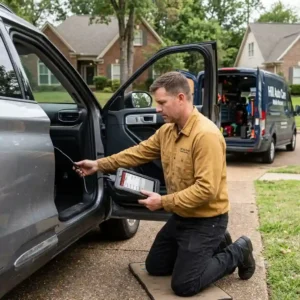
A comprehensive Car Diagnostic Oxford evaluation connects advanced diagnostic equipment directly to your vehicle’s Engine Control Unit (PCM/ECM) and auxiliary modules (such as the transmission, ABS, and body control modules). The Car Diagnostic in Oxford scanner communicates with onboard systems to:
- Retrieve active, pending, and historical Diagnostic Trouble Codes (DTCs).
- Monitor real-time live sensor data streams (such as oxygen sensor output, fuel trim percentages, and mass airflow readings).
- Perform active component bi-directional testing (such as manually commanding fuel pumps or cooling fans to cycle).
- Analyze historical freeze-frame data captured at the exact moment a fault occurred.
Understanding OBD Fault Codes: Why a Code Is Not a Part
One of the most common misconceptions in modern auto repair is believing that a trouble code explicitly names the exact part you should replace.
When a sensor reading strays outside normal operating parameters, the vehicle’s computer logs a fault code. For example, a P0171 code indicates a “System Too Lean (Bank 1).” This code does not mean your oxygen sensor is broken; it simply indicates that the engine is receiving too much air or too little fuel. The underlying cause could be a cracked vacuum hose, a dirty mass airflow sensor, weak fuel pump pressure, or clogged fuel injectors.
Relying solely on a code printout without complete Car Diagnostic Oxford troubleshooting often leads to replacing perfectly functional components while the original problem remains unresolved.
When Should You Schedule a Car Diagnostic Check?
Onboard computers monitor virtually every core system in modern vehicles. Seeking timely Car Diagnostic Oxford assistance is recommended when experiencing symptoms across these primary areas:
1. Illuminated Dashboard Warning Lights
Whether it’s a Check Engine light, ABS indicator, Traction Control light, or Airbag warning, an illuminated dashboard icon means an onboard computer has logged an operational error that requires Car Diagnostic Oxford analysis.
2. Drivetrain & Performance Hesitation
If your engine misfires under load, stutters during acceleration, or idles roughly at red lights, a Car Diagnostic Oxford scan evaluates ignition timing, cylinder misfire counts, and fuel delivery performance.
3. Intermittent Electrical & Sensor Glitches
Electrical issues can manifest as erratic gauge readings, sudden accessory failures, or unexpected warning messages.
4. Mysterious Shuddering or Vibrations
When physical vibrations accompany engine or drivetrain faults, pinpointing whether the cause stems from ignition misfires, engine mounts, or suspension components requires systematic testing. Learn more in our detailed article on Car Shaking While Driving Oxford MS.
Common Diagnostic Scenarios and What They Reveal
| Symptom / Light | Common Fault Codes | Potential Underlying Causes Discovered via Car Diagnostic Oxford Testing |
| Check Engine Light (Flashing) | P0300 – P0308 | Active cylinder misfire; bad spark plug, failing ignition coil, or clogged injector. |
| Check Engine Light (Solid) | P0420 / P0442 | EVAP system leak (loose gas cap), failing catalytic converter, or O2 sensor drift. |
| Rough Idle & Poor Gas Mileage | P0101 / P0172 | Contaminated Mass Air Flow (MAF) sensor or leaking intake manifold gasket. |
| Hard Starting or Long Crank | P0335 / P0340 | Camshaft or crankshaft position sensor signal loss preventing prompt ignition. |
When long cranking or starting failure occurs without an active check engine light, explore our dedicated breakdown on Starter Motor Repair Oxford.
What Happens After Fault Codes Are Retrieved?
Retrieving fault codes is merely the first phase of a thorough Car Diagnostic Oxford investigation. Once initial DTCs are logged, a technician performs pinpoint physical testing to confirm the diagnosis:
- Live Data Analysis: Verifying whether live sensor voltage values match manufacturer specifications during your Car Diagnostic Oxford check.
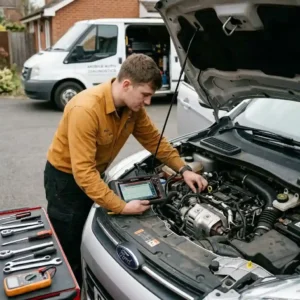
- Circuit & Continuity Testing: Using a digital multimeter (DMM) to check for short circuits, open wires, or voltage drops in sensor harnesses.
- Mechanical Smoke & Pressure Testing: Applying smoke testing to locate hidden intake/EVAP leaks or testing fuel rail pressure with a mechanical gauge.
- Physical Inspection: Checking for corroded connectors, burnt wiring, cracked vacuum lines, or fluid contamination.
If diagnostic testing uncovers thermal management or cooling system errors, check our safety guide on Car Overheating Oxford MS.
Transmission & Drivetrain Diagnostics
Modern automatic and continuous variable transmissions (CVTs) rely on dedicated Transmission Control Modules (TCMs) to manage hydraulic pressure and electronic shift solenoids.
When you experience slipping gears, delayed engagement, or harsh shifting, a specialized Car Diagnostic Oxford scan checks TCM data streams, fluid temperature readings, and solenoid circuit resistance. Catching electronic transmission faults early prevents severe mechanical wear.
Why Choose Mobile Mechanic Diagnostics in Oxford, MS?
When an amber warning light appears or your vehicle begins running unpredictably, driving across town or waiting in a crowded repair shop waiting room can be inconvenient—and in cases of active misfires, driving further can damage your catalytic converter.
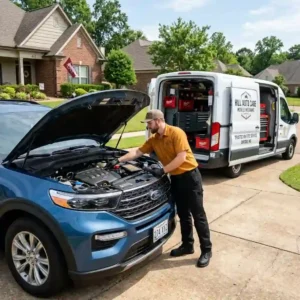
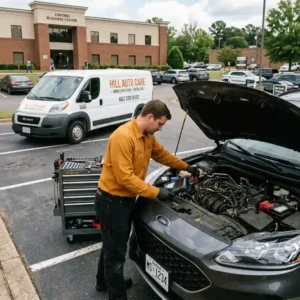
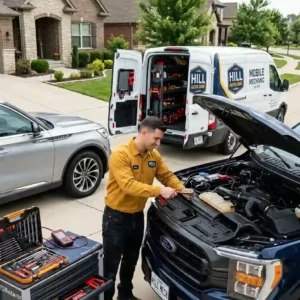
Mobile Car Diagnostic Oxford services bring dealership-level diagnostic scanners and testing tools directly to your home driveway, workplace parking space, or campus location. An on-site Car Diagnostic Oxford evaluation allows a technician to test your car under real-world local conditions while saving you time and towing costs.
To explore all on-site inspection and mechanical repair capabilities available throughout Lafayette County, visit our primary SERVICES page.
Ford & Lincoln Computer Diagnostics
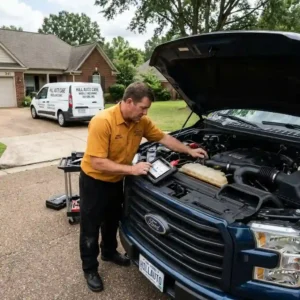
Ford and Lincoln vehicles feature sophisticated computer architectures utilizing Ford’s proprietary diagnostic protocols. Systems like the Powertrain Control Module (PCM), Body Control Module (BCM), and Smart Charge systems require specialized scan tools to access deeper module routines, power balance tests, and network communications during a Car Diagnostic Oxford service.
At HILL AUTO CARE, we provide targeted Ford and Lincoln Car Diagnostic Oxford testing right at your location. Whether your F-150 displays an engine wrench light or your Lincoln SUV exhibits module communication errors, our mobile service delivers accurate, dealer-level diagnostic assessments.
Learn more about our technical standards and convenient mobile approach on our ABOUT US page.
What to Do When a Warning Light Comes On
If a warning light turns on or your car behaves unusually while driving around Oxford, follow these practical steps before scheduling a Car Diagnostic Oxford check:
- Note the Light’s Behavior: A solid Check Engine light indicates a non-emergency fault that should be diagnosed soon. A flashing Check Engine light indicates a severe misfire that can destroy the catalytic converter—pull over safely and turn off the engine.
- Document When Symptoms Occur: Pay attention to whether the issue happens during cold starts, under hard acceleration, at highway speeds, or while idling.
- Check Basic Fluid Levels: Verify engine oil, coolant, and brake fluid levels.
- Schedule a Mobile Car Diagnostic Oxford Test: Have a professional perform an OBD scan and live data analysis to identify the exact cause before replacing parts.
For detailed information on vehicle onboard diagnostic systems and OBD-II standards, consult the official guide provided by the United States Environmental Protection Agency (EPA).
Frequently Asked Questions
What is the difference between an OBD code scan and a full diagnostic test?
An OBD code scan simply pulls trouble codes stored in the computer. A full Car Diagnostic Oxford test analyzes live sensor data, tests electrical circuits, and performs physical component checks to find the exact root cause behind the code.
Can I drive my car if the Check Engine light is on?
If the light is solid and the car drives normally, you can drive short distances to get it checked. If the Check Engine light is flashing, stop driving immediately and request a Car Diagnostic Oxford evaluation to prevent severe engine and exhaust system damage.
Why did my Check Engine light turn off on its own?
Onboard computers re-test systems periodically. If an intermittent fault (such as a temporary sensor glitch or loose gas cap) doesn’t recur after several driving cycles, the light may turn off, though historical codes remain stored in memory for Car Diagnostic Oxford retrieval.
Can a mobile mechanic perform the same diagnostics as a repair shop?
Yes! Mobile mechanics use advanced, professional-grade diagnostic scan tools, digital multimeters, and physical testing equipment capable of performing comprehensive Car Diagnostic Oxford procedures right at your location.
Will a diagnostic test tell me exactly how much repairs will cost?
Yes. Once a comprehensive Car Diagnostic Oxford evaluation identifies the specific failed component or wiring issue, a technician can provide an accurate repair estimate based on verified facts rather than guesses.
How long does a car diagnostic test take?
Most initial Car Diagnostic Oxford scans and verification tests take between 30 and 60 minutes, depending on the complexity of the electrical or mechanical issue.
Pinpoint Your Vehicle’s Issue Today
Don’t let dashboard warning lights or unexplained engine symptoms keep you guessing about your car’s safety and reliability. Moving from assumptions to a precise Car Diagnostic Oxford evaluation protects your engine, saves money on unnecessary parts replacement, and ensures peace of mind on the road.
If you need accurate Car Diagnostic in Oxford testing or expert vehicle troubleshooting, contact HILL AUTO CARE today through our CONTACT US page or explore our full suite of mobile repair options on our SERVICES page!